Fractions are deceptively difficult. I have seen many parents agonize over how to explain concepts like 1/4 or 2/5 to an eight-year-old without simply resorting to rote formal operations. Paradoxically, I only fully realized the complexity of basic fractions by taking a detour into deep theory. While reading Weibel’s An Introduction to Homological Algebra, I found a fascinating exposition on the categorification of fractions—known as localization.
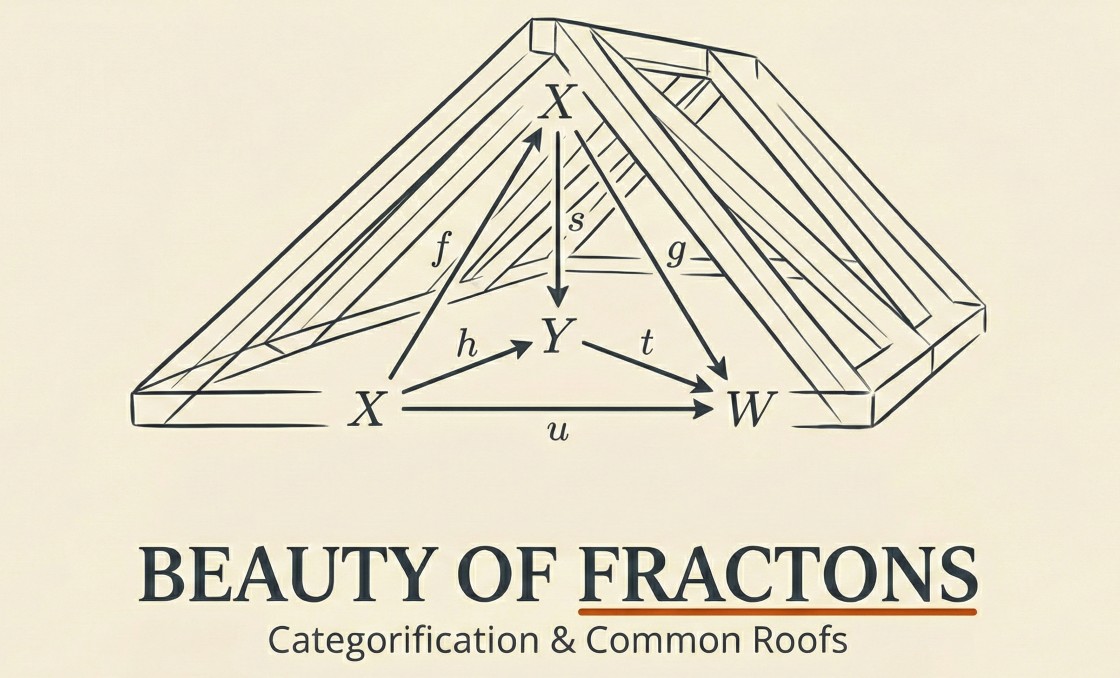
(A quick technical note: for the sake of rigor, we assume all categories discussed here belong to a Grothendieck universe and that the multiplicative system is locally small on the left. However, these set-theoretic details are not the focus of the article.)
1. Multiplicative system
Definition. A multiplicative system
in a category
is a collection of morphisms that satisfies the following three self dual axioms:
1.
is closed under composition and contains all identity morphisms for all objects in
;
2. (Ore condition) For each pair
with
, there is a weak pullback
such that
in
. The dual statement is also valid (there exists a weak pushout with respect to a pair of morphisms in
and
);
3. (Cancellation) For each parallel morphisms
in
, the following two conditions are equivalent:
(3.a) there is a weak coequalizer ofin
, namely,
for some
with
;
(3.b) there is a weak equalizer ofin
, namely,
for some
with
;
1.1. The Spirit of the Ore Condition: Right (Left) Permutability
Origin of the Name
The term comes from the Norwegian mathematician Øystein Ore. In 1931, he studied the problem of embedding a non-commutative ring into a division ring. He discovered that you cannot always form a field of fractions for a non-commutative ring. You can only do it if the ring satisfies the Ore Condition.
Intuition
In the localized category
, we want to be able to compose a “fraction”
with a morphism
.
![]()
We want the result to look like a fraction too. But structurally, this composition is
. The
is “trapped” on the right. This is fine.
However, consider composing two fractions:
![]()
This looks like
. To simplify this into a single (left) fraction (form
), we need to move the
past the
. We need to “commute” them.
We want to find
and
such that
. Multiplying by
on the left and
on the right (conceptually), we get
.
This is exactly the Ore Condition (the weak pullback). It guarantees that any zigzag of morphisms can be reduced to a single roof (a span
).
1.2. The Spirit of Cancellation: Zero Divisor
Intuition
In ring theory, two fractions are equal if and only if
![]()
which implies
.
In this concrete term, the property of an element in
as a zero divisor (i.e. t(a-b)=0) is, in a categorical phrasing, well translated into the existence and the left cancellability of such an element of
.
When we want to define an equivalence relation on fractions, we need to know when two parallel morphisms
become equal in the localized category.
Further, the equivalence of conditions (3.a) and (3.b) asserts that it doesn’t matter which side you multiply on. Indeed, it imposes
to behave as a collection of isomorphisms.
If
kills the difference on the left, there must be a
that kills it on the right.
With these axioms, every morphism in
is just a fraction
.
2. Localization
Definition. Let
be a collection of morphisms in a category
. A localization
of
with respect to
is a category together with a universal functor
in way that:
Any functor
such that
is an isomorphism for all
factors in a unique way through
.
The definition ensures that
is unique up to equivalence (of category) and
is an isomorphism in
for all
.
Although localization with respect to a multiplicative system provides a formal definition, it leaves open the question of computation. Specifically, we lack a concrete representation for the morphisms in the localized category. This is known as the problem of constructability.
3. Construction of localization
Calculus of Fractions
While there are two primary methods for this construction1, Weibel follows the later approach of defining fractions via equivalence classes.
Definition. Given a multiplicative system
in a category
, a (left) fraction with respect to
is a chain in
of the form
with
and
.
By denoting the collection of all (left) fractions as
, we introduce an equivalence relation
on
. This gives rise to the construction (and hence the existence) of the localization
. By the very definition of localization, this object is unique up to equivalence.
Definition. A fraction
is called equivalent to
, if there is a fraction
fitting into a following commutative diagram in
:
When I first saw this, my immediate reaction was: “Well, why does the equivalence of fractions take this form? And why must a third fraction,
, be introduced?”
In the literature, this shape is called a Common Roof or Common Span. While the definition is complicated and might seem overwhelming to the untrained eye, I felt that this categorical interpretation effectively “factorizes”—or deconstructs—the essential complexity inherent in fractions.
In commutative ring, we say
if and only if
. We can simply swap the denominators.
In a general category, we cannot do this because the domains of
and
(
and
) are different objects, and morphisms don’t commute. We cannot compare
and
directly — so we need a Common Denominator to compare them. The 3rd fraction (or the object
) acts as this common denominator.
It will be clear if we imagine when we check if the fractions
and
are equal, but we are not allowed to multiply numbers to cancel the denominators.
We then look for a common refinement—a third fraction that maps to both of them.

If we have two arbitrary fractions
and
, showing they are equal amounts to finding a third fraction
(usually with a much larger denominator
) that simplifies down to
and simplifies down to
.
The properties of equivalent relation
If we defined equivalence as: there exists a map
such that diagrams commute, this relation would not be symmetric. Furthermore, this allows the transitivity to be shown along with the Ore Condition, for which we are not giving a proof here.
